All I remember from reading Annie Dillard
Montaigne assembled a library of about 1,000 volumes. We know that as a student he was made to read Cicero and Horace and did not enjoy the experience. He did enjoy Ovid’s Metamorphoses and Virgil’s Aeneid and Lucretius, Terence, Plautus, and Italian comedies. He took to Tacitus and Plutarch, especially Plutarch. And he described himself as someone who forgot most of what he read: “[If] I be a man of some reading, yet I am a man of no remembering.”
Which is how I felt when I tried to recall anything from my reading of Annie Dillard. She died on September 15. She was 81. I have read most of what she wrote. I’ve read the luminous Pilgrim at Tinker Creek two or three times, and The Writing Life twice, the second time when I taught it to writing students at Johns Hopkins University. I thought she was extraordinary: a hyperacute observer, an incisive thinker, a precise craftsman, and a poetic stylist. She was Henry David Thoreau with a sense of humor. Writer Sam Anderson wrote that it was her mission “to crowbar surprise, sentence by sentence, into all the tiny gaps of our ordinary experience,” and I would not argue with that.
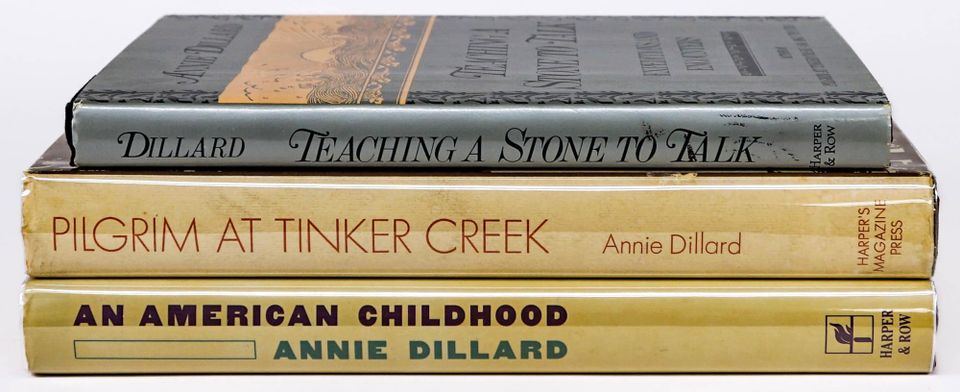
Her writing dazzled me, and moved me, and surely influenced my own work, and I thought her sentences were superb examples of what could be done with the language. But after her death I could not remember any of them. I could recall the effect on me of Pilgrim and Teaching a Stone to Talk and The Living and An American Childhood, and especially her profound meditation For the Time Being—the value of intense observation, the openness to wonder, the bafflement at life’s paradoxes and pain and beauty. They got inside my mind to a rare degree. But I have a better memory for high school football team nicknames than I do for passages from her work. I doubt I could even write a one-paragraph précis of anything of hers I read. There you go, Montaigne.
But in pondering all of this I did find two passages that surfaced in my memory. Both are from her superb 1989 bookThe Writing Life. First, this:
Spend it all, shoot it, play it, lose it, all, right away, every time. Do not hoard what seems good for a later place in the book, or for another book; give it, give it all, give it now. The impulse to save something good for a better place later is the signal to spend it now. Something more will arise for later, something better.
In my experience, most writers are not let-it-fly people, not inclined to say, Hell yeah, just throw it all on the page, give it everything you’ve got, prose bursting with exuberance. Writing applies reason to experience and reason is a containment vessel. Most of us preemptively tamp down strong feeling and put a fence around the inchoate when we write, even in that first draft that by design is meant to be awful and out of control. And most of us live with the fear, however slight or buried, that one day, despite Dillard’s reassurance, we’ll wake up and realize we’ve spent it, we no longer have it. We can’t define “it” but we’re certain that when it’s gone we’ll never write anything good again. So, spend it all? Then what? Finally, spending it all and shooting it all and losing it all carries the risk of looking silly, and boy is that scary. Didn’t seem to scare Annie Dillard, but it scares me.
That’s why, I think, I remembered those four sentences. Do you want to write as well as Annie Dillard? Well, that’s what it takes. She didn’t fear looking silly. She didn’t fear using herself up, because life would always send something her way to light her up again. What I took away was that time and again you have to dance at the edge of chaos, and write as if this were your last chance, the last time you will ever commit words to the page. When Dillard wrote she unfurled the banners. Step up or step away.
The second bit:
When you write, you lay out a line of words. The line of words is a miner’s pick, a woodcarver’s gouge, a surgeon’s probe. You wield it, and it digs a path you follow. Soon you find yourself deep in a new territory. Is it a dead end, or have you located the real subject? You will know tomorrow, or this time next year.
This is more than advice on method. This is a whole epistemology, not to mention an essayist’s credo, whether she intended that or not: Pay attention to what you see and think and feel, to your senses and mind and heart, and then put down a mark, hazard a sentence and see if it tells you anything, clarifies anything, nudges you toward something that hadn’t yet occurred to you but seems to be rustling around just beyond the light. Then make another sentence, one that follows the first. Then another. It will be slow going, but what would you rather be doing?
Going back through her work after reading of her death, I found something in Teaching a Stone to Talk that I hadn’t remembered, but suspect I will remember now. I offer it as a coda:
The thing is to stalk your calling in a certain skilled and supple way, to locate the most tender and live spot and plug into that pulse. … I think it would be well, and proper, and obedient, and pure, to grasp your one necessity and not let it go, to dangle from it limp wherever it takes you.
Yes.
You've been wracking your brain trying to remember something, and it comes to you: Don't forget to become a voluntary paid subscriber to The Joggled Mind! Yeah, that was it!
Member discussion