This idea will self-destruct in 30 milliseconds; you will remember nothing
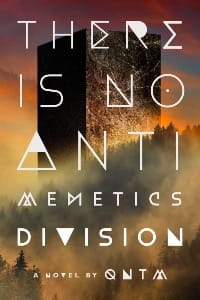
In 2023 I stumbled upon praise for a novel with the curious title There Is No Antimemetics Division. The author wrote as “qntm” with no further details. I read the book and was impressed. After learning a bit more, I scribbled this in my monthly Joggled Mind book report:
[English computer programmer Sam] Hughes self-publishes all his work under the nom de internet qntm. I don’t remember how I came across him, but I bought this volume for my iPad and loved it. It’s about a secret foundation that battles “anomalies,” various threats to the world which hide behind antimemetic camouflage—that is, anybody who encounters one immediately forgets about it. Clever and entertaining. The man deserves a commercial publisher.
Someone at the commercial publisher Ballantine Books apparently agreed. They brought out a hardcover edition last year. Hughes said it had received “a total end-to-end editorial overhaul” and I thought the new version was even better.
It’s not easily characterized. The protagonist, Marie Quinn, directs a secret agency called the Unknown Organization. The UO hunts, contains, and neutralizes “Unknowns”: bizarre, often predatory entities with numerical designations—U-055, U-3125—that have long escaped detection because anyone who encounters them immediately forgets them. Hughes calls them “self-keeping secrets.” How do you protect yourself from something you can’t remember ever noticing? No memory, no notice, no alarm, no resistance.
Hughes is extraordinarily clever building his implausibly plausible fictional world of massive secret labs and containment facilities in England, and scientists who sometimes must take meticulous hand-written notes because they know when they leave the room they will forget everything they’ve just observed. The Unknowns are creepy, often horrifying, sometimes invisible, sometimes only ideas. Readers may need to write their own notes to keep straight the novel’s oscillating chronology (the book slyly reminds us how quickly we forget the details of most everything we read), but this qntm universe is tremendous fun, even when you find yourself unstuck in its narrative time.
Occasional mordant humor leavens the dark proceedings. Quinn tolerates a parasitic Unknown, U-4987, “an invisible monster that follows me around and likes to eat my memories…. I produce tasty memories on purpose so it doesn’t eat something important.”
Hughes probes deeper ideas beneath the entertainment, though. At the novel’s core lies the concept of ideatic space. Ideatic space is a parallel ecosystem—an alternate universe made of ideas that behave like living organisms. There they replicate, spread, compete, evolve, and do what they must to preserve themselves when they cross the porous barrier to physical space. Some survive by being memorable. Some, like Marie Quinn’s antagonists, endure by being intentionally unmemorable. What happens in the book’s abstract ideatic space can have catastrophic effects on physical reality. In Quinn’s world, antimemes kill.
Homo sapiens has survived for millennia by organizing ourselves into cultural and social structures. We learned to communicate, cooperate, connect, exchange value, plan, and contribute to the common good. But as families begat clans begat tribes begat large complex societies, our innate drive to survive begat fear and suspicion of People Not Like Us. By the time humans started writing things down, thus creating history, they no doubt had been suffering for centuries from toxic opportunists more than happy to exploit this fear and suspicion to gain power over the local population, then over People Not Like Us.
I don’t know which came first, the malignant ideas or the despots, but the ideas have proven to have longer shelf lives. The worst refuse to die. A few examples from a long sordid list:
- People with black skin are inferior to people with white skin and so not entitled to dignity, justice, or equity.
- Women are inferior to men, so their subordination is natural.
- Indigenous peoples are godless savages who have no right to land, resources, or their own cultures; nor are they entitled to justice.
- Jews secretly control much of the world and need to be marginalized, if not exterminated.
- Only Christians are right, and therefore destined to rule. No wait, only Muslims are right. No wait, only Hindus are right.
Calling them “memes” or “invasive organisms from ideatic space” is metaphorical, as is the notion of them burrowing into our world to wreak havoc. Memes don’t instigate bad behavior—they have agency in Hughes’s fictional universe, not ours. In ours they are used by the deplorable to justify their malevolent actions. But the metaphors can take on substance; after the Nazis or the Maoists or the Klan or the religious fanatics are defeated, the noxious ideas live on like spores. Consider just one: That God granted humans dominion over the earth has endured for millennia, and look where that idea has brought us.
That destructive memes can’t be contained, neutralized, or eradicated by some real-world version of Hughes’s fictional Unknown Organization is not just because they are metaphors. Our inability to defang or contain the spread of toxic ideas may be inevitable; we are bound to the minds we’ve got. We can’t rework our cognitive structures from scratch. We are just as bound to institutional, economic, and political systems that too often reward emotion over reason and dogma over thought. Neurostructure and systemic forces ensure no end of bad ideas and bad actors weaponizing them.
Societies have made progress toward justice and equity, but it’s glacial and prone to reversal. If, following Hughes’s thought experiment, we cast virulent ideas as organisms dedicated to their own survival, we begin to see what might have inspired his idea of antimemetic traits. Whole populations do forget and resist reminders of what happened the last time a terrible idea got loose. White supremacists in the US seem to have no cultural memory of the American Civil War—which was fought over slavery and extinguished 700,000 lives. Modern-day communists blithely forget the realities of the Soviet Union or Mao or Pol Pot. Anti-vax extremists need to be reminded of polio. Misogynists eager to seal boardroom doors or elected offices to keep out women seem oblivious to the naked fact that just about every disastrous decision made in the last 800 years was made by a man. Donald Trump doesn’t seem to remember Iraq and Afghanistan. Potentially more damaging are his administration’s efforts to erase large pieces of American historical and cultural memory. I’m surprised he hasn’t slapped his brand on it: Trump Antimemesis.
The failure to recollect, neutralize, and contain ideas of mass destruction is an existential threat. We keep failing, and one day that might wipe us out. When the smoke clears or the dust settles or the microbes die out, I imagine elephants sifting the wreckage and saying to one another, “Humans. They just never learned.”
Coda:
- There Is No Antimemetics Division may be purchased from Dr Essai's Bibliothéque.
- Hughes’s minimalist website, Things of Interest.
The Joggled Mind is supported solely by you, dear Jogglers. No advertising, no crafty product placement, no dark money (though that last one sounds cool). To volunteer as a paid subscriber, doink the button below. As always, thank you for reading.
Member discussion