Tracy Kidder

By my late 20s, I had committed to becoming a writer. In the years between my college graduation in 1976 and this commitment, I had been paid to tend the giant tape drives of a computer that occupied an entire massive room, spent some miserable months in corporate marketing, worked as a printing estimator, failed as a print salesman, collected unemployment, and spent about a year performing as a singer-songwriter. Other musicians told me I was pretty good, but my total earnings from a few dozen gigs were a festival t-shirt. Though I was introduced to my wife, who was in the audience for an open mic night, so I did come out ahead.
I’d had some success as a student journalist and I’d never actually decided not to write, so I bought a fancy electric typewriter and in my 27th year went all in on becoming a scribbler. But of what sort? At first I wrote anything that paid: high school sports, restaurant reviews, calendar copy, resumés. I wrote text for those annoying marketing inserts that fell out of your monthly bank statement back when those came in the mail. I wrote “In Search of the Ultimate Honeymoon Suite,” and a story about a singing arachnologist, and a story about underground cancer treatments while my mother was dying from cancer. I covered city council meetings in small Kentucky cities for $10 a column inch. I wrote an atlas for dirt bike riders, promo copy for the Jersey Shore, and a tourist guide to Celina, Ohio, a nice community that was pretty short on tourists. As an undergraduate, I had planned to be a novelist, but that plan unraveled once I tried it. Daily reporting for a newspaper didn’t appeal to me. Under the spell of Bruce Chatwin, Paul Theroux, Patrick Leigh Fermor, and Jan Morris, I imagined myself as a travel writer, but my obligation to my marriage wasn’t imaginary and I couldn’t see myself spending six months alone walking through Baluchistan with a rucksack, a notebook, and a host of intestinal parasites.
Writers often find their way by stumbling across someone else’s work that captivates them, often a book that prompts them to say, “I want to write that.” For me, the formative volumes were Coming into the Country by John McPhee, The Electric Kool-Aid Acid Test and The Right Stuff by Tom Wolfe, Pilgrim at Tinker Creek by Annie Dillard, and House by Tracy Kidder. Those are disparate titles, to be sure, but what they had in common that so affected me was their deep research and reporting, their intellectual heft and thoughtfulness, their vibrant storytelling, their braid of the closely observed external world and what the writer’s own quirky mind made of it, and the literary quality of their prose. The authors were recognized as superb craftsmen, but to me they were more. They were artists.
Tracy Kidder died this past week, at age 80. Many readers of narrative nonfiction who are my age first encountered him with his 1981 book about engineers building a computer. The Soul of a New Machine won a Pulitzer Prize, but for whatever reason I didn’t pay it any attention. I first read him when The Atlantic, in September 1985, published an excerpt from House, a book that chronicled the construction of a custom home near Amherst, Massachusetts. Kidder portrays the husband and wife who commission the house, the architect who designs it, and the quartet of carpenters who raise it. Their interaction is complex and sometimes fraught and Kidder seems to have noted all of it. Near the top of the excerpt in The Atlantic, he described the initial grading of the building site. On the scene is Jim Locke, the carpenter who will manage the project, and the Souweines, who will own the house once it’s finished.
When Locke has begun to wonder whether it is coming at all, it appears — a small, yellow machine on a large trailer. Locke gives the driver instructions, while the others hang back. The bulldozer puffs smoke and clanks down off the trailer. The first pass the machine makes over the ground, ripping the hair off the earth, looks like an act of great violence. The bulldozer does resemble a beast, but the creature is both unruly and extremely methodical. Gradually the sense of disruption goes out of the scene. The machine goes back over the same, suddenly dark ground. Piles of earth mount up. The hole deepens and, as sand appears, turns orange. Watching the bulldozer work is restful and mesmerizing. Its noise discourages speech, leaving each member of the party alone and thoughtful.
This group does have a few worries. They have not settled all the details of the plan. They have not arrived at a final price for the house. They have not yet signed a contract. Jim Locke wanted all of that done before this day. He felt that he had to go ahead, knowing that if he delayed he might not get the excavator for weeks. But Locke can imagine events that would leave him holding the bill for this work. He and the Souweines have begun to build on faith, without much knowledge of each other.
The party lingers a while. The bulldozer's cab begins to sink beneath the level of the field.
The acute observation, the vivid detail, the first hints of a psychological subtext, all of it arrested my attention. Kidder’s obituary in The New York Times quoted the writer Stuart Dybek, who was Kidder’s friend: “Narrative journalism freed him. Every day we go by people building a house. Tracy goes by people building a house and he sees stories there. He sees characters there. It sounds simple — but try to do it.” Indeed.
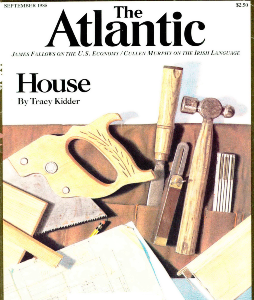
As soon as I could I bought the book. I’d never read anything like it. How could 352 pages about something as commonplace, as mundane, as the building of a house, be so engrossing? I turned the last page and thought, This. This is what I want to do.
I didn’t become Tracy Kidder any more than I became John McPhee or Annie Dillard or Tom Wolfe. Of course not. That wasn’t the point. When I needed lodestars, when I needed exemplars, their books beckoned. To a floundering, unraveling young man, each one said, Follow me.
Kidder wrote 11 books. Actually, he wrote 12, but he hated his first one, The Road to Yuba City: A Journey into the Juan Corona Murders, so much he disowned it. In 1995, he said, “I can't say anything intelligent about that book, except that I learned never to write about a murder case. The whole experience was disgusting, so disgusting, in fact, that in 1981 I went to Doubleday and bought back the rights to the book. I don't want The Road to Yuba City to see the light of day again.” Of the 11 he allowed to stay in print, I’ve read six. The ones I most wish I’d written are House, Among Schoolchildren, and Home Town.
For Among Schoolchildren, Kidder went to a grade school in Holyoke, Massachusetts every day for nine months, sitting at a child’s desk in the fifth-grade classroom of Chris Zajac, a young, idealistic teacher, and filling a notebook a day with all he observed. (The image of him seated in class is comical. Kidder was constructed on the dimensions of a football tight end.) The introduction of his spirited central figure is wonderful descriptive writing, clear and observant, subtle and emotionally resonant:
She was 34. She wore a white skirt and yellow sweater and a thin gold necklace, which she held in her fingers, as if holding her own reins, while waiting for children to answer. Her hair was black with a hint of Irish red. It was cut short to the tops of her ears, and swept back like a pair of folded wings. She had a delicately cleft chin, and she was short — the children’s chairs would have fit her. Although her voice sounded conversational, it had projection. She had never acted. She had found her voice in classrooms.
Mrs. Zajac seemed to have a frightening amount of energy. She strode across the room, her arms swinging high and her hands in small fists. Taking her stand in front of the green chalkboard, discussing the rules with her new class, she repeated sentences, and her lips held the shapes of certain words, such as “homework,” after she had said them. Her hands kept very busy. They sliced the air and made karate chops to mark off boundaries. They extended straight out like a traffic cop’s, halting illegal maneuvers yet to be perpetrated. When they rested momentarily on her hips, her hands looked as if they were in holsters. She told the children, “One thing Mrs. Zajac expects from each of you is that you do your best.” She said, “Mrs. Zajac gives homework. I’m sure you’ve all heard. The old meanie gives homework.” Mrs. Zajac. It was in part a role. She worked her way into it every September.
Many years ago, I met Kidder at a narrative journalism conference in Boston, where he was a presenter. He was affable, self-effacing, not much of a public speaker. I imagined he preferred to be a listener. He signed a copy of Among Schoolchildren “To Dale,” and I value it. He once said that what he most wanted to do was write about good people doing good work, and he did so time and again — a charismatic engineer, hard-working carpenters, a school teacher, a cop, an American doctor who hiked miles alone in the Haitian backcountry to treat tuberculosis patients.
I admire professionalism. Even more I admire dedication to doing whatever the creation of superb work demands; I respect and sometimes marvel at the ambition and the sacrifice and the respect for craft and artistry that goes into that. When I taught nonfiction writing at Johns Hopkins University, I sometimes told my students, “If three phone calls seem enough to get what you need, make 10 calls. Then when you’re tired and impatient to move on, make an 11th. Then call some of those people back a week later. You will never regret it.” I wanted a lot from them, and I wanted a lot for them. I didn’t say it, but a small part of me wanted them to want what I had wanted as I found my own path — to be Tracy Kidder.
Coda
The Kidder books I most recommend include the two I have described here, House and Among Schoolchildren, plus Home Town, a sort of narrative street anthropology of Northampton, Massachusetts, and Mountains Beyond Mountains, Kidder’s moving book about the physician and public health crusader Paul Farmer. Follow the links to buy them from my corner of Bookshop.org.
Thank for reading, dear Jogglers. The Joggled Mind is self-supporting. We don’t take ads and we don’t sell your data. If you’d like to help by becoming a voluntary paid subscriber, you are one click away from doing so. See you next time.
Member discussion