Hello, I’m an INTJ Maven Maker Analytic Architect. And you are?
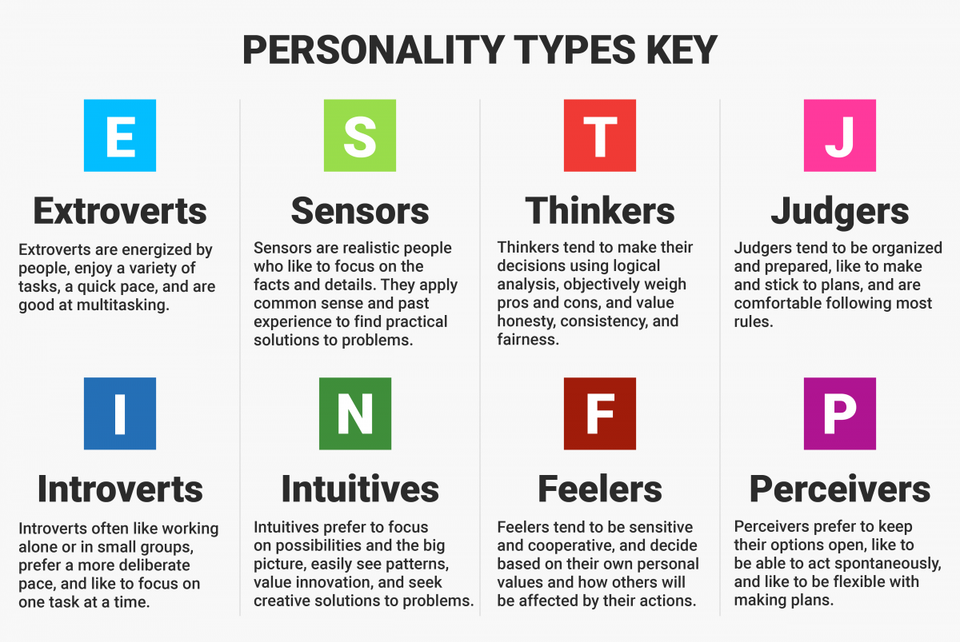
Years ago, senior management ushered everyone in my university communications department into a workshop on the Myers-Briggs Type Indicator. This was for…I still don’t know what. For those not familiar with the Myers-Briggs system, it was devised by Katharine Cook Briggs and her daughter Isabel Briggs Myers, and purports to draw on Carl Jung’s ideas about the human psyche to categorize one’s personality. For no added cost, it promises insight into what lies behind individual human behavior. Are you an extrovert or an introvert? Someone who thinks through a problem, or someone who lets emotion be your guide? Intuitive? Or do you prefer to act on concrete information? Do you like order and a plan, or value spontaneity? The answers align on four axes and produce a four-letter code that designates your personality type. Some people believe this to be useful.
You must be dying to know: If I remember correctly, I was an INTJ—an intuitive loner who favors rationality and can be judgmental. (Surely not.) I found a website that labels INTJs as “The Mastermind”—okay then—and lists among us Jane Austen, Ruth Bader Ginsburg, Lewis Carroll, and Isaac Newton, which is flattering, and Mark Zuckerberg and Ayn Rand, which is mortifying. Another website notes, “While your cognitive abilities are undoubtedly a strength, they can sometimes lead to challenges in the social realm.”
We’ll just leave that one be.
I sometimes amuse myself by dabbling in similar analyses. A few years ago I answered a slew of questions to learn where I scored on a set of personality spectra called The Big Five Personality Model (their caps, not mine), with five axes this time: neuroticism, extraversion, openness, agreeableness, and conscientiousness. The assessment informed me that I am introverted, reserved, and quiet; curious, intelligent, imaginative, and creative, and enjoy variety and change; pleasant, sympathetic, and cooperative; determined and reliable. I haven’t been that flattered since my last chat with an AI agent.
I’ve also completed a Sparktype Assessment, billed by its creators as “Big Data Meets Individual Impact.” Spark Endeavors, the company behind it, claims it helps determine what “sparks” you, so you may find work that will make you feel purposeful, excited, energized, and living in a continual flow state:
Discovering your Sparketype profile, for many, is a moment of awakening, recognition, and revelation. It reveals something that, in truth, most people have always known. And it reminds you that this DNA-deep impulse to exert effort in a particular way matters. More than you imagine. But to even begin to chart a new path forward, we need a new, even more precise, revelatory, and insightful compass—one that empowers you to reimagine and reclaim your work and make better decisions, one that helps you joyfully craft a better way to live and work that truly lights you up. Your Sparketype Premium Profile is that new foundation, your Sparked compass, here to guide you as you set off on the adventure of a lifetime. And a robust compass it is!
And a robust promise that is!
My primary Sparktype is “The Maven.” What sparks a Maven, you ask? “You live to learn. … Just as a flame needs oxygen, a Maven like you needs learning. A void of learning opportunities and experiences can dampen your innate impulse and stifle your Spark.” Turns out, I also have a “shadow” Sparktype: “The Maker.” The attributes of a Maker: creative, innovative, ingenious, artistic, clever, enterprising, imaginative, visionary, inspired, inventive, resourceful, and perceptive. (That is uncannily accurate. The only thing it left out is cute.)
Several things about these analytical tools puzzle me, but what puzzles me the most is why I find them so irritating. It’s not like Myers or Briggs just drove a sedan through my flowerbeds.
My first gripe is the implicit suggestion that they are science-based. There is a sub-economy of coaches, HR professionals, consultants, influencers, and optimizers who promote MBTI et al. as tested, validated methodologies anchored in, based on, or at least adjacent to psychology or behavioral science. They are not. For example, we are told that Myers and Briggs based their program on the insights of Carl Jung. That sounds like a serious credential, but Jung was not a scientist; he was a storyteller. That doesn’t mean he was without insight, but he was without data or rigorous research support. The three brains behind Sparketype? A marketer, a consultant, and a podcaster. They sound like smart guys but scientists or clinical researchers they are not. There is some peer-reviewed research support for the Big Five, but as a diagnostic tool, not a reliable pop psychology quiz.
When I poke at the methodologies, several things arouse my suspicion. First, all these analytical tools rely on people candidly and accurately revealing themselves through their responses to a series of questions. The questions are designed to be value-neutral, free of any hints of judgment, so you’ll be honest and unselfconscious. But who doesn’t have blind spots? Who doesn’t want to create a flattering image of themselves? And everyone taking the MBTI knows they are being assessed. Who wouldn’t want the results to be complimentary? American culture, especially corporate culture, favors energetic, decisive extroverts not afraid to take risks. How could that not color one’s responses, especially if you need a job, or find yourself in a job that you know rewards being a sociable team player? It took me three minutes to find two websites that will help you prep for Myers-Briggs to generate a favorable assessment. For a fee, coaches will train you to hack the test.
Think about it: In response to a series of questions, we tell a software agent (these assessments are all digital now) how we see ourselves, and then the agent takes our answers, tabulates a set of sketchy correlations, and plays them back as a self-affirming profile phrased in non-threatening, flattering terms and packaged in a plausibility wrapper meant to discourage us from dismissing the results. The profiles always make us sound like fascinating, capable, thoughtful exemplars of some archetype. You don’t think I smiled when Sparktype “objectively” assessed me as just the sort of black-clad artsy loner I want to see in the mirror? Even that bit about “challenges in the social realm” pleased my punkish self. Would any of these assessment tools last long in the marketplace if they sifted through your responses and informed you that you are an arrogant, cynical, amoral asshole? I have no doubt Sparktype would find a way to make even that profile sound redeeming.
On an evening stroll, I chatted with my wife about Myers-Briggs and why I think it’s bunkum. She believes MBTI can be useful, especially in a corporate context. It makes people aware of fundamental behavioral traits, and potentially helps them better work together and understand themselves, she said. So people need a personality assessment to tell them what’s in plain sight, such as they prefer crowds because they’re extroverts? Yes, she said. Most people are not observant or reflective, and Myers-Briggs helps them. I don’t get it, I said. She smiled and replied, “You just enjoy being a grump.”
Okay, I’ll concede the contradiction of being personally annoyed by these tests yet amusing myself by taking them…maybe my wife is right, I enjoy being annoyed. But no matter how many people find something useful in Myers-Briggs et al., the convenience and reassuring packaging obscures a true cost. Squaring up to how little we know about ourselves and each other, attending to the clues to the mystery so that we might fashion more meaningful lives—that is a life’s work. It’s an exasperating, confounding task. Just when we think we’ve made some progress, something smacks us sideways and we wonder if we know anything at all. There’s something offensive, at least to me, in the glib promise that you can reduce this project—and your wild, complex self—to sixty questions and a four-letter code, or a label like Maven, Sage, or Warrior. Hell no.
When I was a teenager, my father told me a story. After the Second World War, he’d spent five years in art school learning to paint and sculpt, and now he was supporting my mother and me as a sign painter. Not the most creative guy—though good at it, he wasn’t driven to paint, he just enjoyed it—but an excellent draftsman and calligrapher, and the best pictorial sign man in Cincinnati. Just for fun, he told me, in his thirties, after art school and several successful years in the sign business, he took an art aptitude test.
It said he should be a plumber.
Thank you for reading, dear Jogglers. The Joggled Mind will always be free, but if you would like to become a Generous Voluntary Paid Subscriber, please doink the button below.
Member discussion