U of Paris Class of 1215 accused of doing nothing but learning
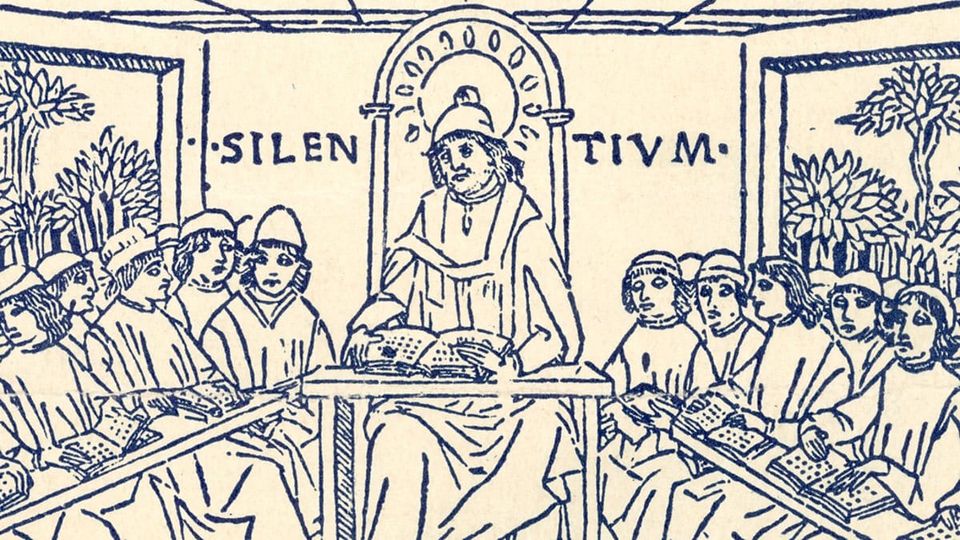
Dr Essai dearly loves one of his professional responsibilities: to venture down every digressive path that comes his way. Meandering curiosity is mandated by the Essayist's Code of Conduct (rev. 2026–C), and the doctor never met a digression he didn’t like. (Editors in his previous line of endeavor knew not to encourage this trait.)
So Essai was delighted when, for his ever-expanding rumination on the books he has not yet read (a project sprouting more tentacles than a squid), delving the history of university syllabi and required reading lists, he found a letter from a papal legate named Robert de Courçon. The letter, dated August 1215, prescribed rules for the University of Paris:
Robert, servant of the cross of Christ, by the divine mercy cardinal priest with the title of St. Stephen in Monte Celio and legate of the Apostolic See, to all the masters and scholars at Paris eternal greeting in the Lord.
Let all know, that having been especially commanded by the lord pope to devote our energy effectively to the betterment of the condition of the students at Paris, and wishing by the advice of good men to provide for the tranquility of the students in the future, we have ordered and prescribed the following rules.
M. de Courçon then establishes the qualifications for becoming a professor. You will note that, for universities in general, these have changed somewhat over the years.
No one is to lecture at Paris in arts before he is twenty years old. He is to listen in arts at least six years, before he begins to lecture. He is to promise that he will lecture for at least two years, unless he is prevented by some good reason, which be ought to prove either in public or before the examiners. He must not be stained by any infamy.
That last bit no doubt ruled out some interesting minds, but remember, we’re dealing with the papacy here.
Next came what Dr Essai was after, the list of required reading. M. de Courçon mandated Aristotle’s treatises on logic, specifically Categories, On Interpretation, Prior Analytics, Posterior Analytics, Topics, and On Sophistical Refutations, as well as Nicomachean Ethics. Also, “the two Priscians, or at least the second, are to be read in the schools in the regular courses.” This referred to Institutes of Grammar by the Latin grammarian Priscian, at the time a standard Latin textbook. A second Latin primer made the list, Barbarismus, which was the third book of Ars Major by Donatus. And Topics by Boethius, but only the fourth book. Why only that one? Not recorded. A curious feature of de Courçon’s directive was a not-to-be-read list: “The books of Aristotle on Metaphysics or Natural Philosophy, or the abridgments of these works, are not to be read, nor ‘the doctrine’ of master David de Dinant, of the heretic Almeric [contemporary spelling Amalric], or of Maurice of Spain.” Those last three had run afoul of the church for, among other things, rejecting the sacrament of transubstantiation because God was already present in all things — no need for wafers or wine. Essai likes to imagine a scruffy Parisian college kid, new to campus, reading that with a smirk and immediately enlisting his friends in a hunt for Almaric’s Physion, a Treaty of Natural Things, to be surreptitiously sampled with much wine and giggling.
The doctor does not know what to make of this next paragraph:
If any one of the students in arts or theology dies, half of the masters of arts are to go the funeral, and the other half to the next funeral. They are not to withdraw until the burial is completed, unless they have some good reason. If any master of arts or theology dies, all the masters are to be present at the vigils, each one is to read the psalter or have it read. Each one is to remain in the church, where the vigils are celebrated, until midnight or later, unless prevented by some good reason. On the day when the master is buried, no one is to lecture or dispute.
Already delighted by this find, Dr Essai could not believe his luck when he discovered an appended document titled “Life of the students at Paris,” written by a sourpuss named Jacques de Vitry. M. de Vitry was not impressed by what he had observed:
Almost all the students at Paris, foreigners and natives, did absolutely nothing except learn or hear something new. Some studied merely to acquire knowledge, which is curiosity; others to acquire fame, which is vanity; others still for the sake of gain, which is cupidity and the vice of simony. Very few studied for their own edification, or that of others. They wrangled and disputed not merely about the various sects or about some discussions; but the differences between the countries also caused dissensions, hatreds and virulent animosities among them and they impudently uttered all kinds of affronts and insults against one another.
Slinging invective is one thing, but when you accuse someone of the vice of simony, well…
The next paragraph, one presumes, provides illustrative examples of the aforementioned virulent animosities:
They affirmed that the English were drunkards and had tails; the sons of France proud, effeminate and carefully adorned like women. They said that the Germans were furious and obscene at their feasts; the Normans, vain and boastful; the Poitevins, traitors and always adventurers. The Burgundians they considered vulgar and stupid. The Bretons were reputed to be fickle and changeable, and were often reproached for the death of Arthur. The Lombards were called avaricious, vicious and cowardly; the Romans, seditious, turbulent and slanderous; the Sicilians, tyrannical and cruel; the inhabitants of Brabant, men of blood, incendiaries, brigands and ravishers; the Flemish, fickle, prodigal, gluttonous, yielding as butter, and slothful. After such insults from words they often came to blows.
M. de Vitry did not reserve all his invective for the students. He seemed unimpressed by some of the faculty, too:
I will not speak of those logicians before whose eyes flitted constantly “the lice of Egypt,” that is to say, all the sophistical subtleties, so that no one could comprehend their eloquent discourses in which, as says Isaiah, “there is no wisdom.” As to the doctors of theology, “seated, in Moses’ seat,” they were swollen with learning, but their charity was not edifying. Teaching and not practicing, they have “become as sounding brass or a tinkling cymbal,” or like a canal of stone, always dry, which ought to carry water to “the bed of spices.” They not only hated one another, but by their flatteries they enticed away the students of others; each one seeking his own glory, but caring not a bit about the welfare of souls.
Well, as they say, “Those who can’t do become tinkling cymbals.”
Coda
One cannot be certain, but the above sounds a lot like the Jacques de Vitry who studied at U of P before becoming Bishop of Acre in 1214 and a cardinal in 1229. He became a noted theologian and chronicler and wrote Historia Hierosolymitana, which became an important source for historians of the Crusades. There is no way to gauge the accuracy of his ill opinion of the university, but he did join the Fifth Crusade, which casts some doubt on his judgment.
The letters quoted were posted online by Kevin Roddy of the University of California, Davis. Thank you, sir.
And regarding the vice of simony — that was the selling of Church offices or sacred objects, which appears to have vexed the Church as far back as the 4th century CE.
For new Jogglers, if the reference in the second paragraph to a rumination on books not yet read is cryptic, may one refer you to Joggle No. 144?
Thank you for reading.
Please be assured that should you wish to become a paid subscriber to The Joggled Mind, you will not commit the vice of simony. We would never ask that of you.
Member discussion